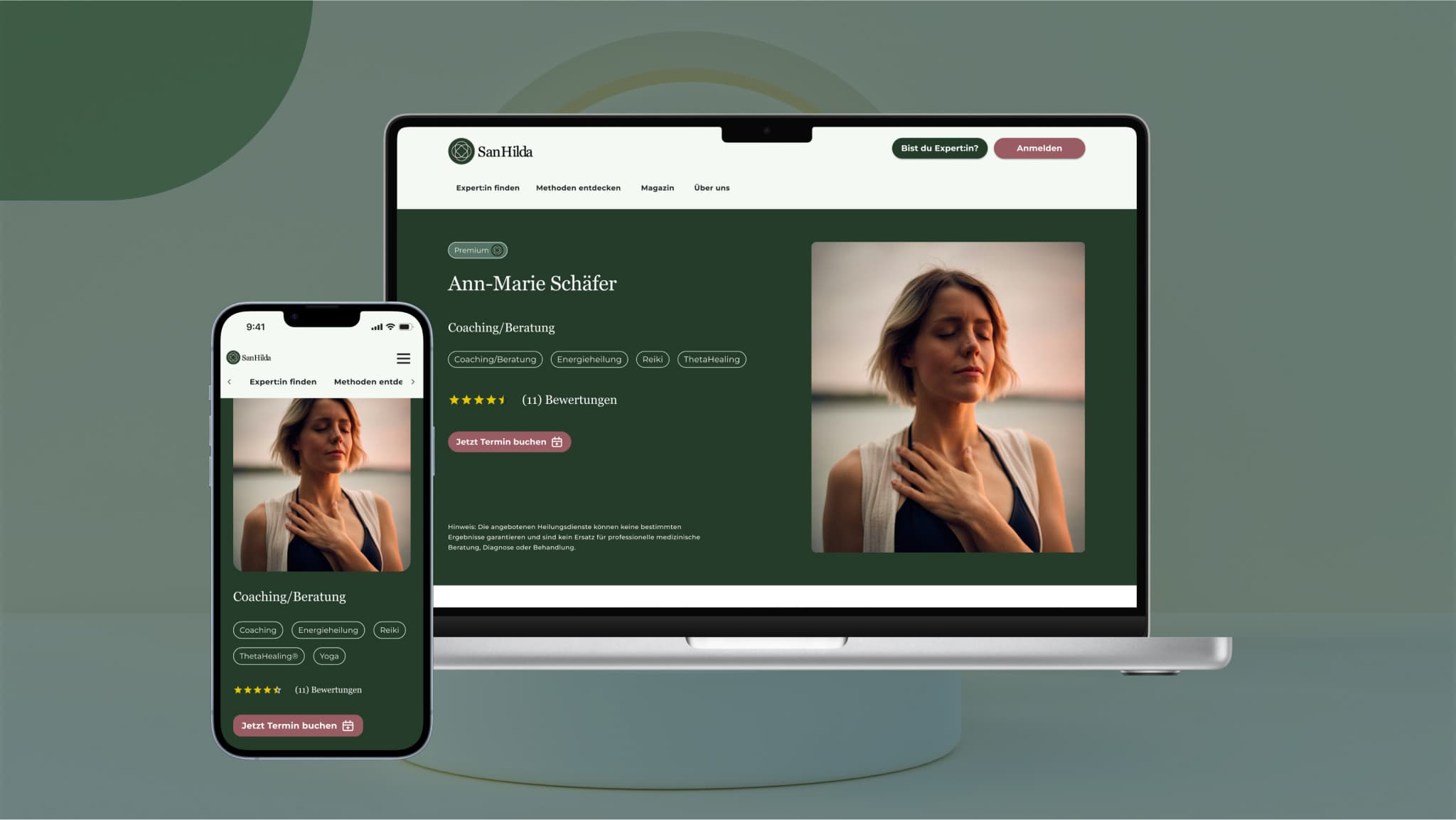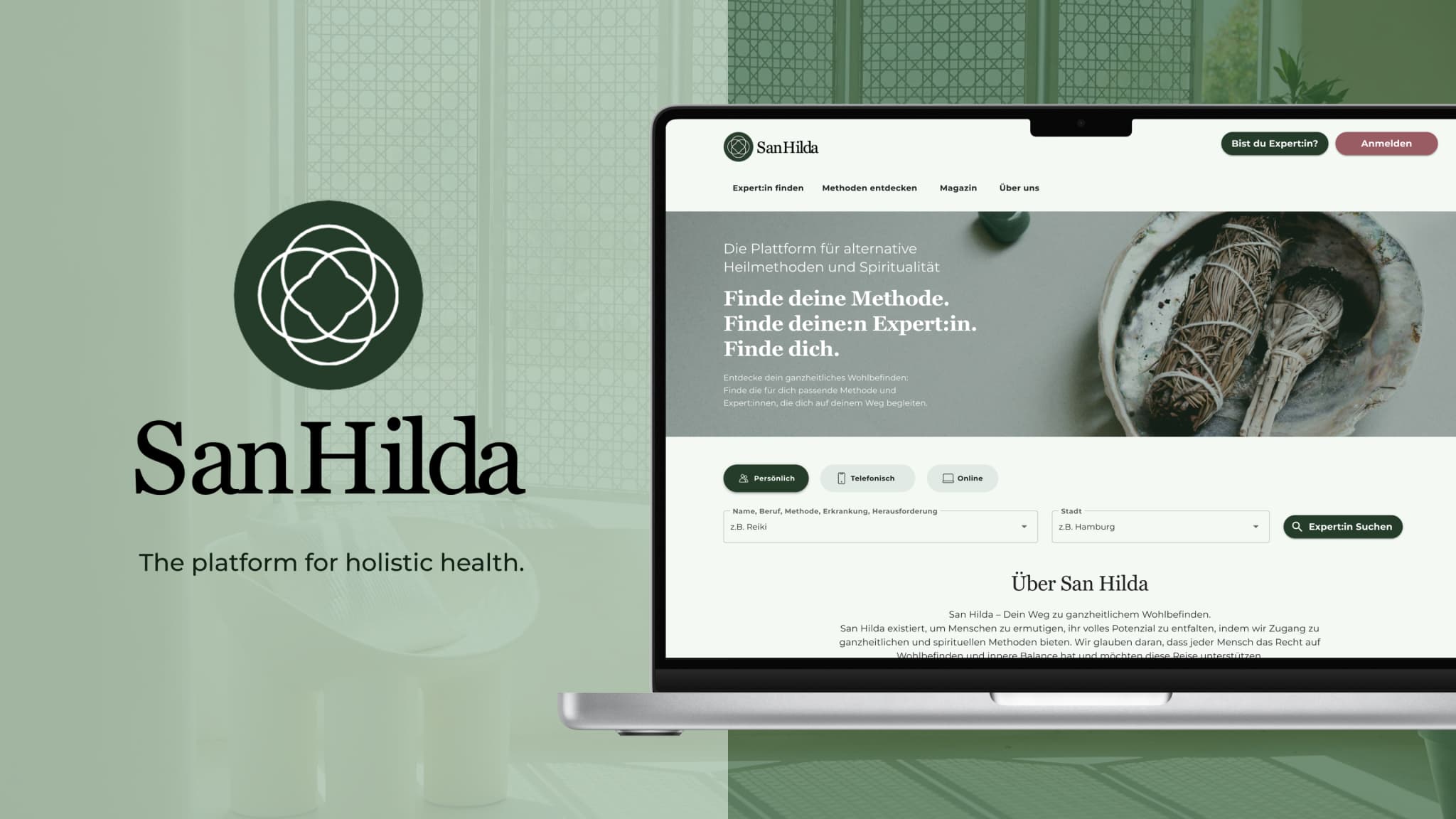
SanHilda GmbH
•Role: Lead Designer & Product Manager, owned roadmap, prioritization, user stories, UX/UI, design system, and QA
•Team: Founder/Client, PO, Devs, Growth/CRM; 2-week sprints; tight design–dev pairing
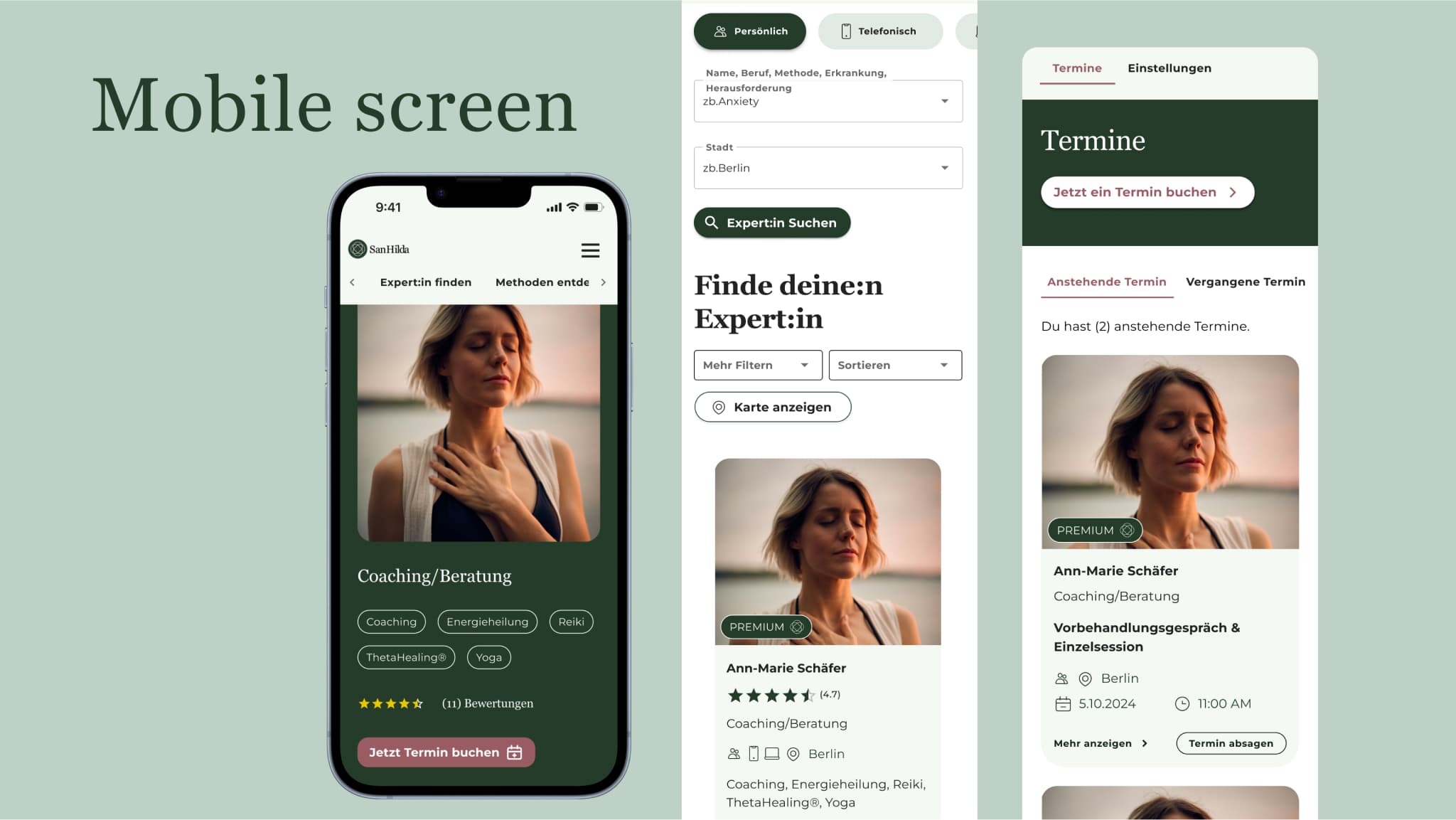
•Scope: Search → compare → book flow; expert onboarding; component library; interactive Figma prototypes
•Tech: WordPress base + third-party booking & payments; analytics via GA + Hotjar
•Outcome: MVP to production in 3 weeks; Phase-2 underway with research-driven refinements
•Why it matters: Created a scalable marketplace foundation that helps clients find the right expert fast and helps experts showcase methods credibly.
Context
San Hilda connects people seeking alternative/holistic healing with vetted practitioners (e.g., Reiki, acupuncture, breathwork). Two-sided marketplace: clients need clarity and trust; experts need a clean way to present methods, qualifications, and availability.Client Feedback:"What truly sets True Node apart is the way they immerse themselves in their clients' world. They become invested in it. The team goes beyond surface-level product development as they deeply understand the client's customers, behaviors, and pain points. In doing so, True Nude often identifies challenges and opportunities that weren't even clear to the client yet."Robin SchlenkhoffCo-founder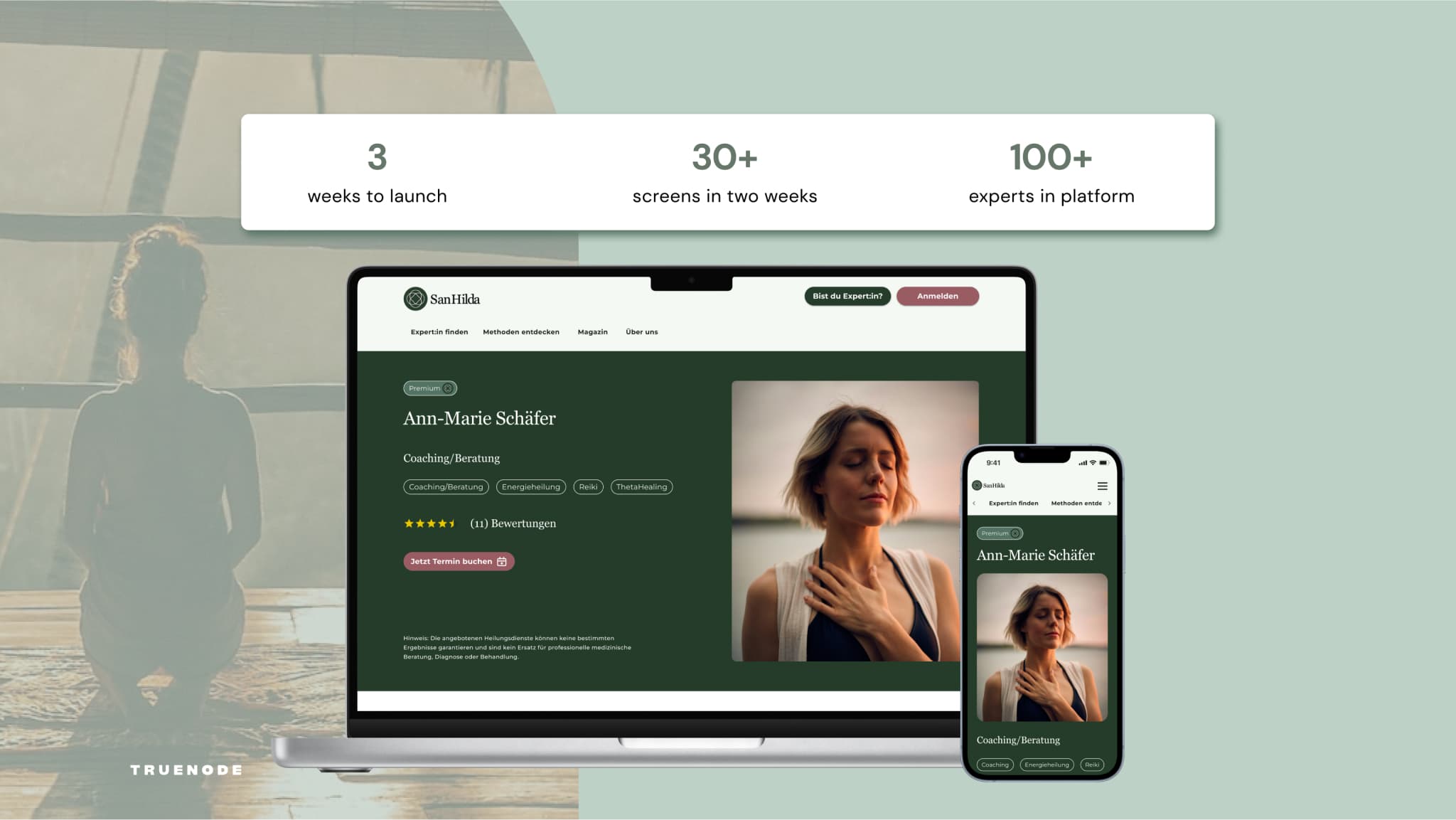
Problem
•Discovery was unfocused: users couldn't easily search by symptom, method, or outcome.
•Experts lacked a structured, credible profile to convey methods, qualifications, and availability.
•No consistent component system → slow delivery, inconsistent UI, and brittle handoffs.
•Stakeholders needed a lean path to MVP without sacrificing scale for later phases.
Strategy
•Make finding simple: homepage search that accepts method or need/symptom; focused filters.
•Design for trust: structured expert profiles (methods, qualifications, pricing, reviews, availability).
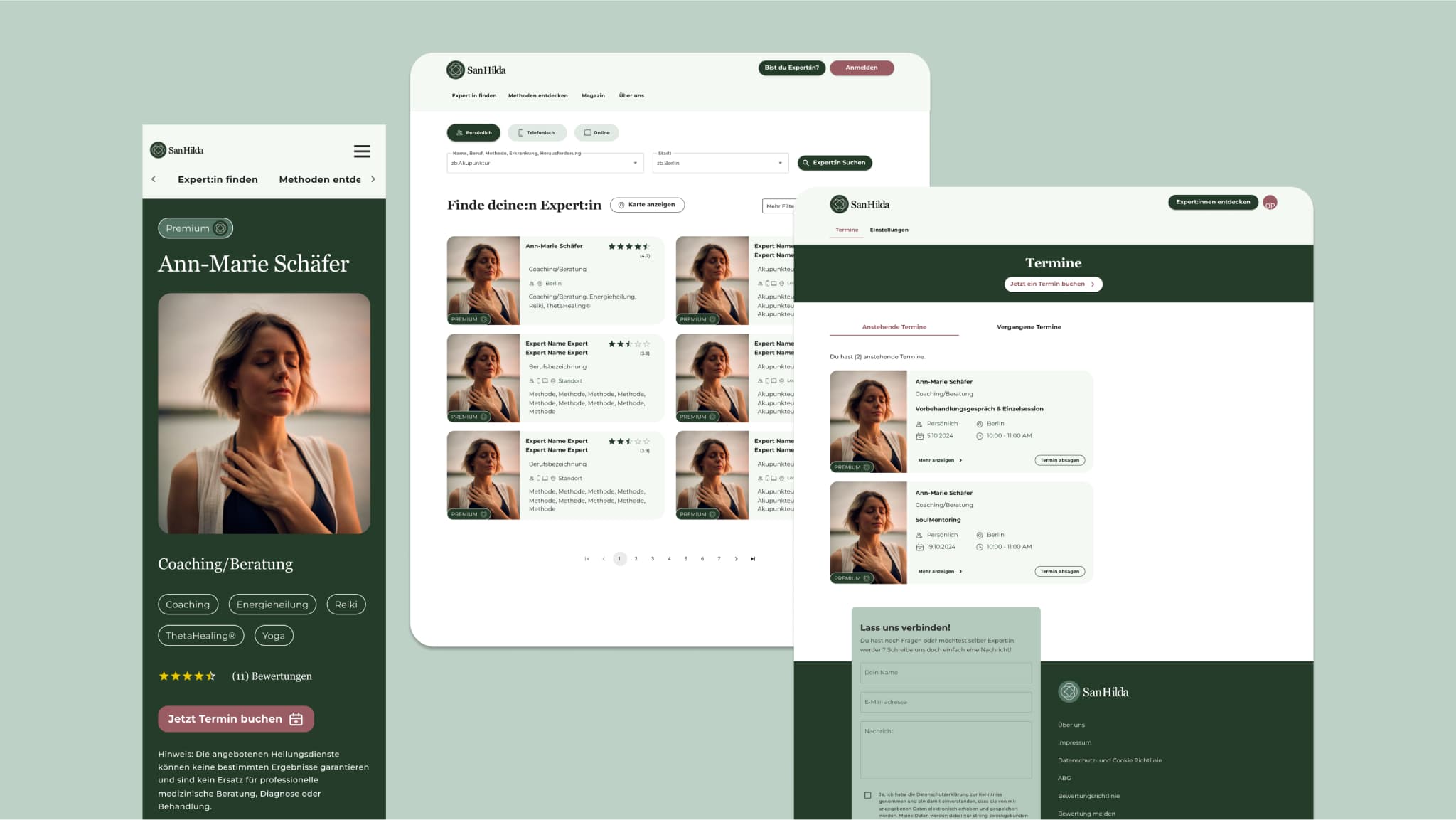
•Shorten time-to-book: clearer list → profile → booking path; resilient forms and confirmations.
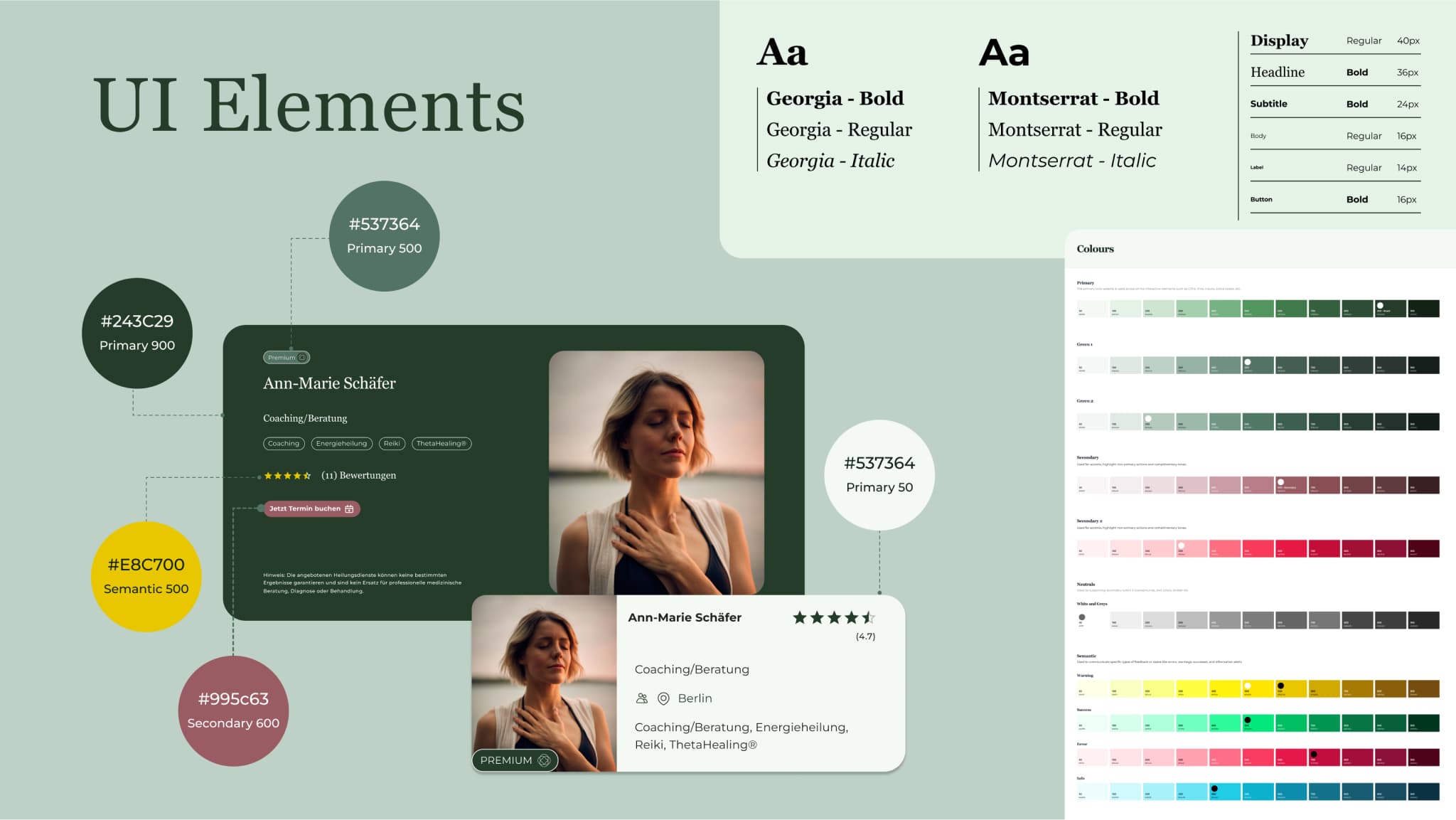
•Scale via system: a reusable component library + mini style guide to speed Phase-2 work.
•Measure early: baseline KPIs (search→profile CTR, profile→booking rate, cancellations, NPS) and instrument the funnel.
Results
•MVP shipped to production in 3 weeks (core search, profiles, booking + payments).
•Established component library in Figma → faster sprint throughput and cleaner handoffs.
•Phase-2 live: guided by GA + Hotjar insights, usability sessions, and expert/client feedback.
•Early indicators (Phase-2 targets; publicly share as relative deltas):
•Search→profile CTR: +8–22% (improved findability and filter clarity)
•Profile→booking conversion: +6–18% (clearer value/availability, fewer steps)
•Time-to-book (median): −20–45% (guided flow, resilient forms, better defaults)
•Cancellation rate: −2–6 pp (transparent expectations, confirmations, easy reschedule)
My role & leadership
•Roadmap & prioritization: translated vision into a lean MVP, then sequenced Phase-2 bets.
•User stories & acceptance criteria: wrote/maintained backlog with clear AC and edge states.
•Design system: created scalable components, tokens, and usage guidance; enforced consistency.
•Stakeholder management: weekly reviews, decision docs, and risk/impact trade-offs.
•Design QA & delivery: annotated specs, paired with devs, unblocked build issues quickly.
Solution highlights
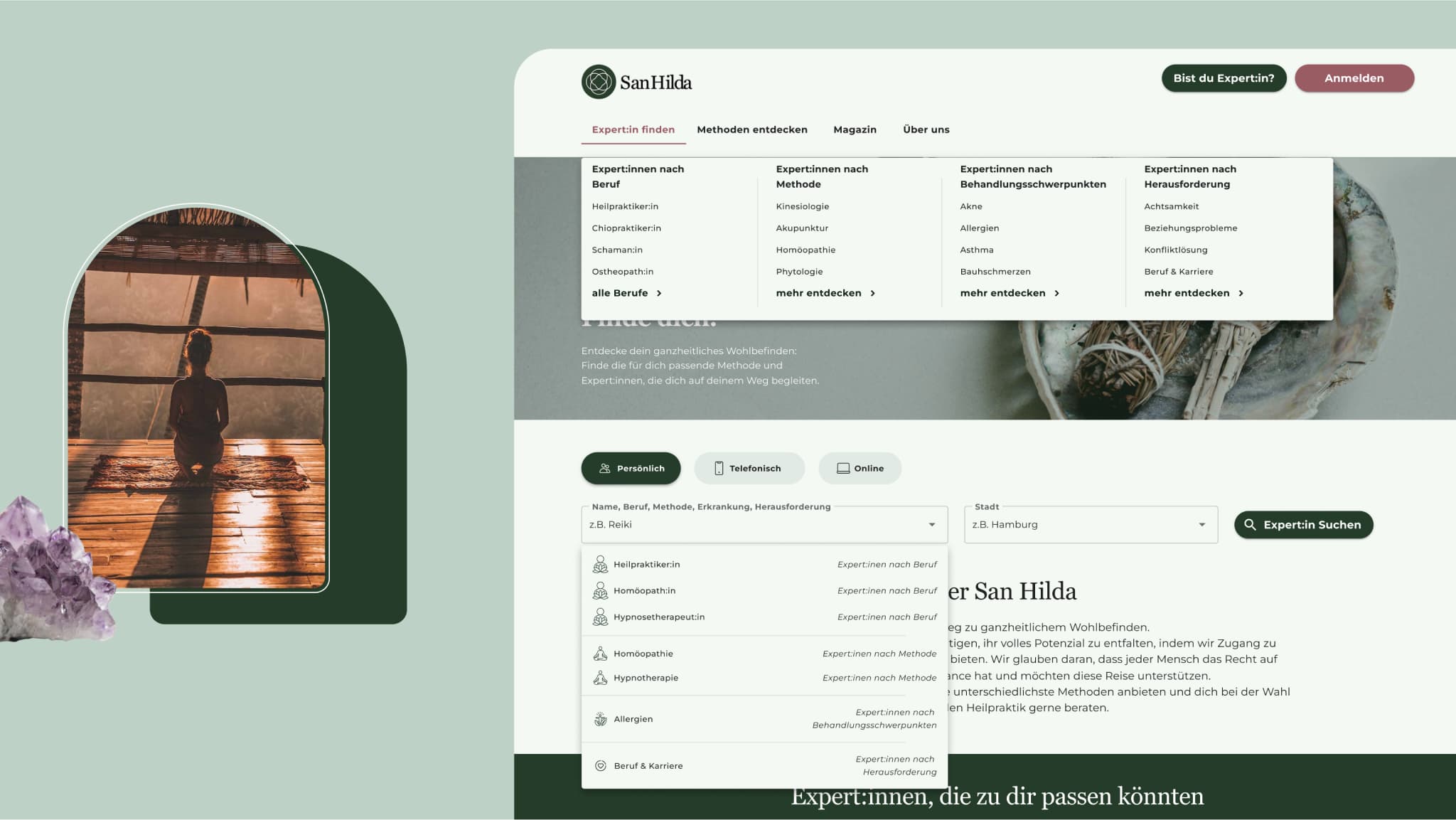
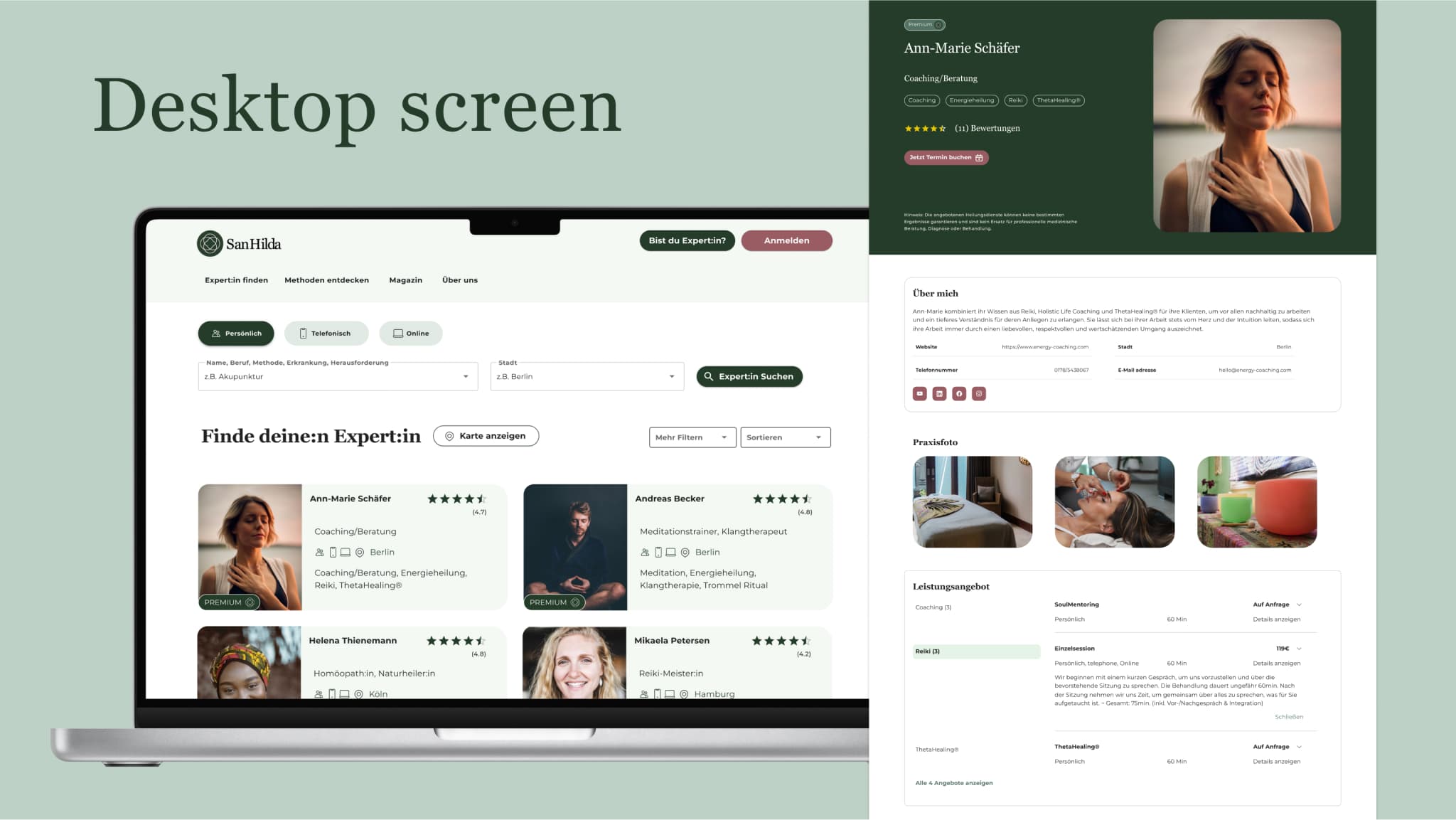
•Unified search (needs or methods): users start with a symptom ("stress", "insomnia") or a method ("Reiki", "acupuncture") and land on focused results.
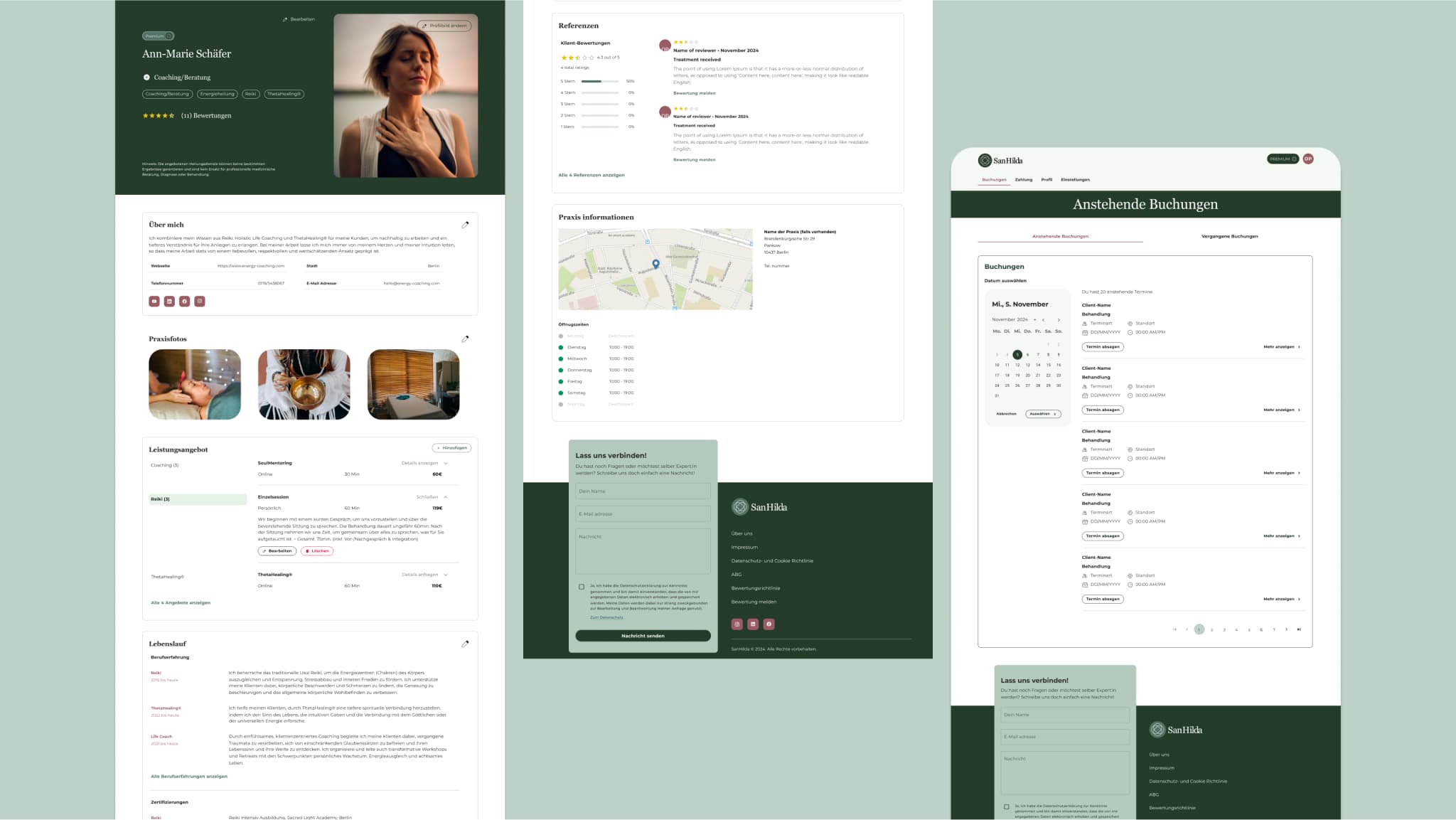
•Structured expert profiles: methods, qualifications, outcomes, pricing, availability, reviews; clear value copy and trust cues.
•Booking that feels light: progressive disclosure, sensible defaults, error-proof forms, and confirmations that reduce anxiety.
•Filters that matter: method, need, availability, price range, language/location—only what helps decide.
•Marketplace integrity: consistent content patterns so first-time visitors can compare like-for-like.
Process
Design discovery•Kick-off workshop → personas, key jobs-to-be-done, and differentiation vs. competitors.
•Benchmarked language, trust elements, and decision cues common in health/wellness marketplaces.
UI + design system•Client/Expert flows mapped end-to-end.
•Built a mini style guide and component library (cards, filters, form elements, schedule modules); documented states (empty/loading/error).
Prototyping•Low-fi wires to validate structure → high-fi interactive Figma prototypes to align stakeholders and speed dev implementation.
Build & integration•WordPress + third-party booking/payment tools; designed around constraints to keep MVP lean.
•Paired with devs each sprint; redlines and AC for edge cases (timezones, cancellations, reschedules).
Measurement & iteration•GA + Hotjar baselines; watched search terms, scroll depth, rage clicks; opened Phase-2 hypotheses based on evidence.
Learnings
•Clarity beats volume: fewer, well-named filters outperform long faceted menus in a wellness context.
•Trust is layered: qualifications + reviews + availability transparency reduce drop-offs more than "brand tone" alone.
•Design the system, not screens: components with documented states shrank delivery time and post-launch bugs.
What's next
•Guided matching: lightweight quiz → recommended experts (method + availability fit).
•Operational tooling: expert onboarding checklist, profile quality score, and flagging for incomplete info.
•Retention loops: post-session follow-ups, packages/subscriptions, and reminders tied to goals.